
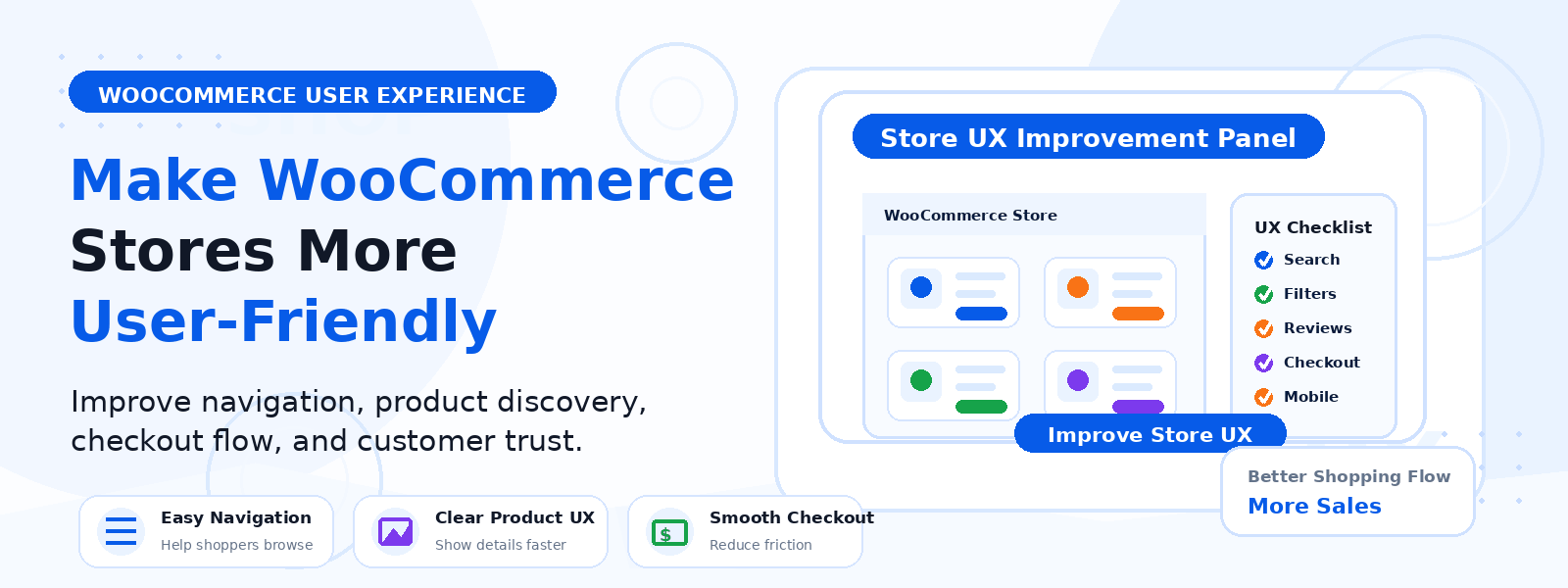
Running a WooCommerce store is about more than just having great products — it’s about creating a seamless, intuitive shopping experience that makes customers feel confident, comfortable, and motivated to complete their purchase. User-friendliness is one of the most critical factors in eCommerce conversion rates, and even small improvements to your store’s usability can have a significant impact on your revenue.
In this guide, we’ll explore the most effective ways to enhance user-friendliness in your WooCommerce store, covering everything from navigation and product discovery to checkout flow and mobile experience.
1. Simplify Your Site Navigation
Customers should be able to find what they’re looking for within two or three clicks of arriving on your homepage. A clear, well-organized navigation menu with intuitive category names is the foundation of a user-friendly WooCommerce store. Use descriptive category labels, avoid overly deep subcategory hierarchies, and consider adding a “mega menu” for stores with large product catalogs. A prominently placed search bar is also essential — many customers prefer to search directly rather than browse categories.
2. Improve Product Page Design
Your product pages are where purchase decisions are made. Make sure each product page includes high-quality images from multiple angles, a clear and concise product description, visible pricing (including any discounts or savings), prominent Add to Cart buttons, and customer reviews. Video demonstrations are increasingly expected for higher-priced products. Remove distractions and keep the focus on the product and the purchase decision.
3. Optimize Product Images
Image quality has a direct impact on buyer confidence. Use high-resolution photos with a zoom feature that allows customers to examine product details up close. Maintain consistent image dimensions across all products so your product listings look uniform and professional. For clothing, accessories, and home goods, show the product in context — on a model, in a room, or in use — to help customers visualize it in their own lives.
4. Streamline the Checkout Process
Cart abandonment is one of the biggest challenges in eCommerce, and a complicated checkout process is one of the leading causes. Reduce friction by enabling guest checkout so customers don’t have to create an account to make a purchase. Minimize the number of required form fields. Offer multiple payment methods including credit cards, PayPal, and local payment options. Display a progress indicator so customers know how many steps remain. And make sure your checkout page loads fast — every second of delay increases abandonment rates.
5. Make Your Store Fully Mobile-Responsive
More than 60% of eCommerce traffic now comes from mobile devices, and mobile shoppers have even less patience for poor user experiences than desktop users. Test your WooCommerce store thoroughly on smartphones and tablets. Check that product images load quickly, buttons are large enough to tap accurately, forms are easy to fill on a touchscreen, and the checkout process works smoothly end-to-end on mobile. Choose a WooCommerce-optimized theme that’s designed with mobile-first principles in mind.
6. Display Clear Trust Signals
First-time customers need reassurance before they’ll enter their payment details. Display trust badges prominently near your Add to Cart and checkout buttons — SSL security seals, accepted payment method logos, and money-back guarantee badges all help reduce purchase anxiety. Customer reviews and star ratings are also powerful trust signals. If your store is relatively new and lacks reviews, consider reaching out to early customers for testimonials or enabling a verified purchase review system.
7. Improve Site Search Functionality
For stores with large catalogs, site search is often the fastest path to purchase. Invest in a search solution that returns relevant results quickly, handles spelling errors and synonyms gracefully, and supports filtering by category, price, color, size, or other product attributes. Consider displaying search suggestions and autocomplete results as customers type to help them find products faster.
8. Make Returns and Shipping Policies Visible
Unclear or hard-to-find return policies are a major barrier to purchase. Display your shipping costs, delivery timeframes, and return policy prominently on product pages, in the cart, and on the checkout page. Consider offering free returns or a satisfaction guarantee if your margins allow it — these policies dramatically increase buyer confidence and can significantly improve your conversion rate.
9. Add Recently Viewed and Related Products
Help customers discover more of your catalog by displaying “Recently Viewed Products” sections and “Customers Also Bought” or “You May Also Like” recommendations. These features keep customers engaged, increase average order value, and make the shopping experience feel more personalized — similar to what customers expect from major eCommerce platforms.
Conclusion
A user-friendly WooCommerce store is one that removes obstacles, builds trust, and makes the journey from product discovery to completed purchase as smooth as possible. By focusing on navigation clarity, product page quality, mobile responsiveness, and a friction-free checkout, you create a shopping environment where customers feel confident and motivated to buy. Implement these improvements progressively, measure the impact on your conversion rate, and continue refining your store over time.