
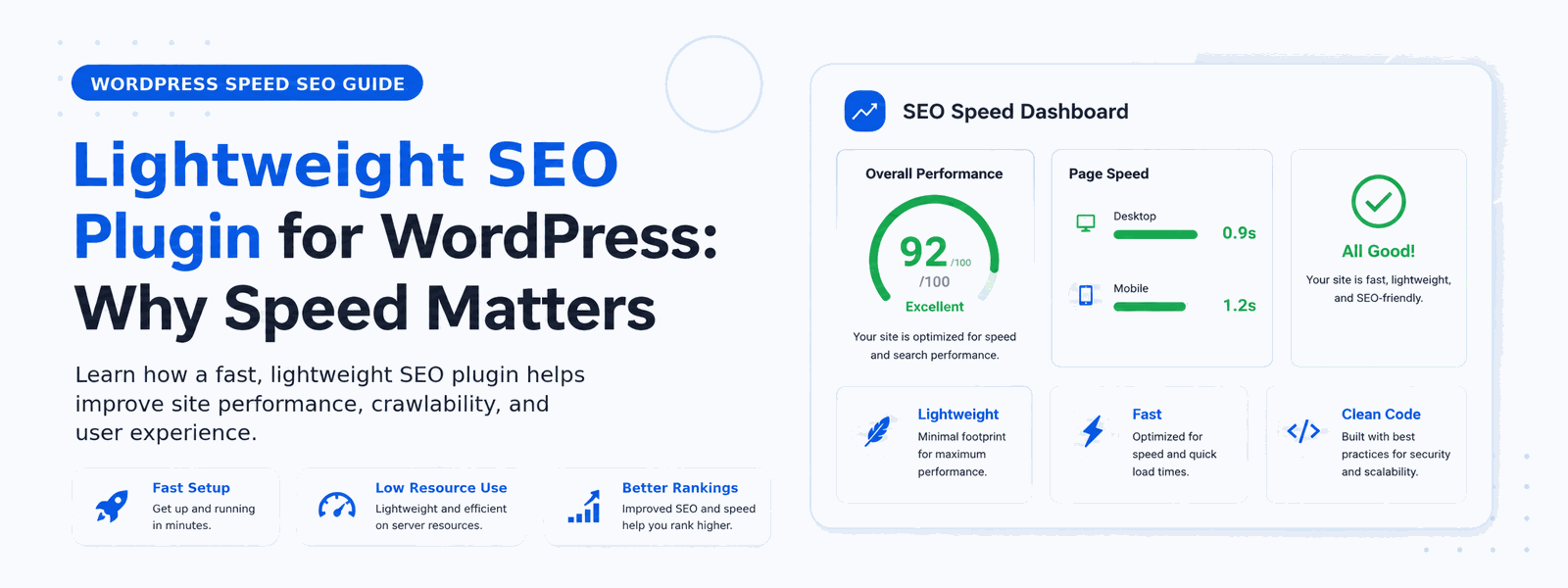
When it comes to WordPress SEO, most website owners focus on keyword research, content quality, and backlinks — but many overlook one of the most impactful factors: the speed of your SEO plugin itself. A heavyweight SEO plugin can slow down every page on your website, directly hurting your search rankings and user experience.
This is exactly why choosing a lightweight SEO plugin for WordPress is not just a preference — it’s a smart SEO strategy in its own right. In this post, we’ll explore why plugin speed matters, how it affects your rankings, and what to look for in a fast, efficient SEO solution.
How Plugin Speed Affects Your WordPress SEO
Google has officially confirmed that page speed is a ranking factor. With the introduction of Core Web Vitals as part of Google’s Page Experience update, metrics like Largest Contentful Paint (LCP), First Input Delay (FID), and Cumulative Layout Shift (CLS) now directly influence where your pages appear in search results.
A bloated SEO plugin that loads excessive scripts, makes multiple database queries per page load, or injects unnecessary CSS can degrade all three of these metrics — even before your actual content has a chance to render. In competitive niches, this performance gap can be the difference between page one and page two of Google.
What Makes an SEO Plugin “Heavyweight”?
Heavy SEO plugins typically suffer from one or more of the following issues:
- Excessive database queries — Some plugins run 10–20 extra database queries per page load, adding latency on every request.
- Large JavaScript files — Admin-side scripts that load on the frontend unnecessarily inflate page weight.
- Redundant features — Built-in social media schedulers, A/B testing tools, and redirect managers add code that most sites never use.
- Plugin size over 5MB — Large plugins take longer to load, update, and execute, impacting both frontend and backend performance.
The Case for a Lightweight SEO Plugin
A lightweight SEO plugin focuses exclusively on what matters for ranking: meta tags, sitemaps, canonical URLs, Open Graph tags, and structured data. By stripping away unnecessary features, it achieves significantly lower database overhead, faster admin screens, and minimal frontend impact.
For websites hosted on shared servers or those targeting a high PageSpeed Insights score, switching from a heavy SEO plugin to a lightweight alternative can result in measurable improvements in load time — sometimes shaving off hundreds of milliseconds per page view.
Speed Benchmarks: Lightweight vs. Heavy SEO Plugins
In real-world testing on identical WordPress setups, lightweight SEO plugins consistently outperform heavy alternatives across key metrics. A clean, minimal SEO plugin can reduce the number of database queries from 30+ down to under 10, reduce total page weight by 50–100KB, and improve admin dashboard loading by several seconds — all of which adds up to a noticeably faster experience for both you and your visitors.
What Features Does a Lightweight SEO Plugin Still Provide?
Despite being minimal in size, a well-built lightweight SEO plugin should still cover all the essentials:
- Custom meta title and meta description for every post, page, and archive
- Focus keyword analysis with on-page SEO scoring
- Automatic XML sitemap generation and submission
- Open Graph and Twitter Card meta tags for social sharing
- Canonical URL management to prevent duplicate content
- Robots.txt and .htaccess editing
- Schema markup support for articles, products, and local businesses
How to Choose the Right Lightweight SEO Plugin
When evaluating a lightweight SEO plugin, look at the total installed size, the number of database queries it adds per page load, and whether it loads any scripts on the frontend. Check if it’s actively maintained with regular updates and good support. A plugin that hasn’t been updated in over a year may have compatibility issues with the latest version of WordPress.
Conclusion
Speed matters in SEO — not just the speed of your server and theme, but the speed of every plugin running on your site. A lightweight SEO plugin for WordPress gives you the essential ranking tools you need while keeping your site fast, lean, and optimized for Core Web Vitals. If you’re serious about performance-driven SEO, it’s time to make the switch to a lighter solution like Codersly SEO.