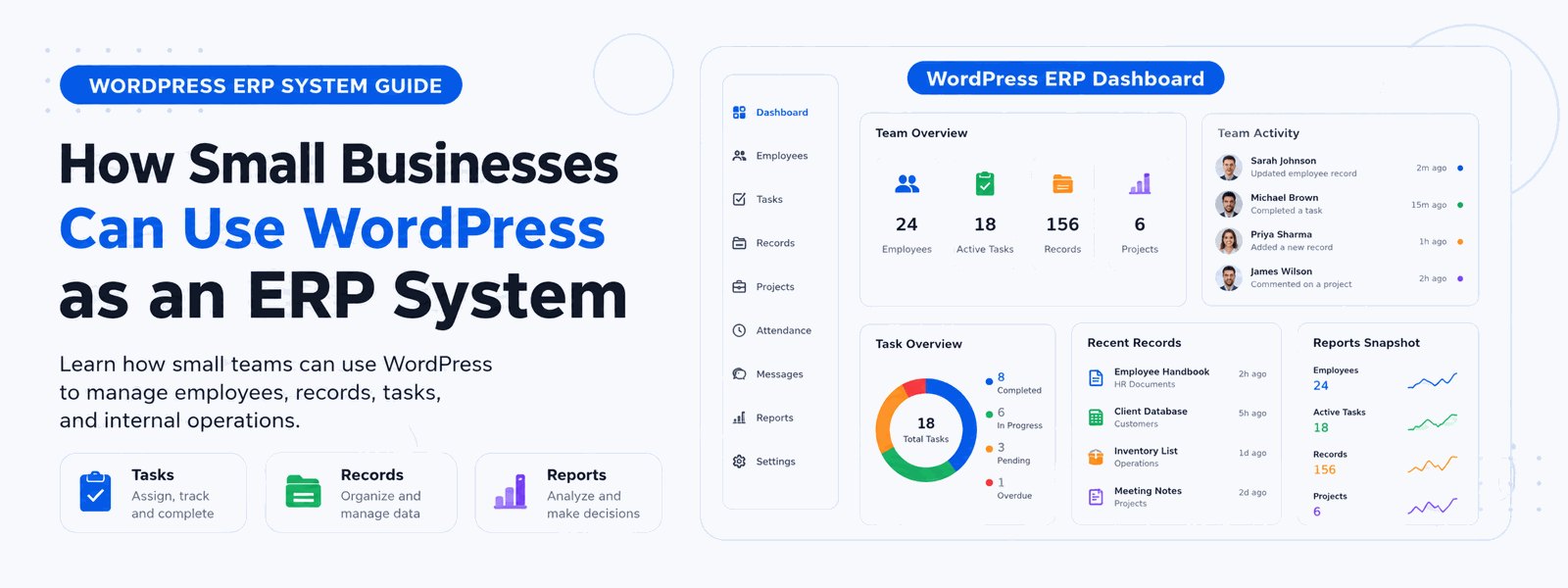
Most small business owners think ERP systems are only for large enterprises with massive budgets and dedicated IT teams. But with the right plugin, your WordPress website can function as a fully capable WordPress ERP system that manages your HR, operations, and customer relationships without the enterprise price tag or complexity. The same platform you use to run your website can become the operational backbone of your entire business.
What Is an ERP System and Why Do Small Businesses Need It?
An ERP (Enterprise Resource Planning) system integrates all core business processes into one unified platform. Instead of managing separate tools for HR, CRM, accounting, inventory, and operations — each with its own login, subscription cost, and data silo — an ERP system brings everything together so information flows freely between business functions. For a small business, this means you can see how employee costs affect profitability, how customer relationships translate to sales, and how operational efficiency improves over time — all from one place.
The Cost Problem with Traditional ERP Solutions
Enterprise ERP systems like SAP, Oracle, and Microsoft Dynamics are designed for large organizations with complex requirements and large IT budgets. Implementation costs often run into tens of thousands of dollars, with ongoing licensing fees in the thousands per month. Small businesses with 5–50 employees simply can’t justify these costs. Cloud-based “SME ERP” alternatives are cheaper but still charge per-user monthly fees that add up quickly. WordPress-based ERP plugins offer a fundamentally different cost model: a one-time purchase that scales with your team at no additional cost.
Why WordPress Is an Ideal ERP Foundation
WordPress’s flexible plugin architecture makes it a perfect foundation for building a small business ERP system. It’s already hosting your website, meaning your team is already familiar with the environment. Adding ERP capabilities through a plugin means one less system to manage, one less login to remember, and one less subscription to pay for. WordPress also benefits from a massive ecosystem of complementary plugins — WooCommerce for eCommerce, payment gateways, communication tools, and more — that can extend your ERP functionality as your needs evolve.
What Business Functions Can WordPress Handle as an ERP?
A well-designed WordPress ERP plugin can replace or supplement several critical business management functions. Human Resources management including employee records, attendance tracking, and payroll processing can be handled entirely within WordPress. Customer Relationship Management with lead tracking, customer profiles, and interaction history integrates naturally with your website. Invoicing and basic accounting for tracking revenue and expenses. Sales dashboard and reporting for monitoring business performance. Project and task management for coordinating team activities. These capabilities collectively make WordPress a legitimate alternative to dedicated ERP software for many small businesses.
Setting Up WordPress as an ERP System
The Codersly ERP Plugin turns your WordPress site into a complete business management system through a straightforward setup process:
- Install the Codersly ERP plugin and activate it in your WordPress dashboard
- Set up your company profile with departments, locations, and organizational structure
- Add departments, roles, and employee profiles with their relevant information
- Configure attendance and leave management policies tailored to your business rules
- Set up CRM modules to manage customers, leads, and business relationships
- Start tracking and managing business operations from one unified dashboard
Integration with Your Existing WordPress Ecosystem
One of WordPress ERP’s biggest advantages is how naturally it integrates with tools you’re already using. If you run a WooCommerce store, your customer data from online purchases can feed directly into your CRM. If you use a contact form plugin, inquiries can automatically create lead entries. Your website content, marketing, and business operations all live within the same platform, creating efficiencies that standalone business tools can never achieve.
Real Benefits for Small Businesses
Small businesses that switch to WordPress-based ERP management consistently report significant operational improvements. Businesses using WordPress as an ERP save 5–10 hours per week on administrative tasks by eliminating manual data transfer between systems. Software costs typically drop by 60–70% compared to maintaining separate HR, CRM, and accounting subscriptions. Team coordination improves dramatically through centralized data access that gives everyone the same current information. And data quality improves because there’s only one system of record for each business function.
Conclusion
Your small business can have a professional ERP system without the enterprise price tag or complexity. Start with Codersly ERP and transform your WordPress site into a powerful business management platform that grows with your business.